

2023 Hyundai Ioniq 6 Vs Tesla Model 3
Over the last decade, electric vehicles (EVs) have gained widespread popularity. In 2011, worldwide EV sales were roughly 55,000 units. A decade later, that figure leaped to nearly 7 million. Many things happened over the years that contributed to this meteoric rise.
The first EVs targeted those green-minded buyers who had a thrifty approach to driving. As a result, early EVs lacked the comfort, convenience, and performance that mainstream automobiles possessed.
However, automakers like Hyundai soon realized the potential of this vertical market and began equipping EVs with all the creature comforts you’re looking for. In addition, steady improvements in the electric powertrain led to a more powerful performance than gas-powered vehicles.
In this article, we’ll look at two cutting-edge EVs looking to capture the hearts and minds of drivers — Hyundai’s IONIQ 6 and the Tesla Model 3. We asked our EV experts to compare these vehicles in an epic EV duel to help you make an informed buying decision. View our extensive inventory of new Hyundai vehicles or give us a call at 817-367-4000 to learn more today!
Hyundai EV Performance and Range
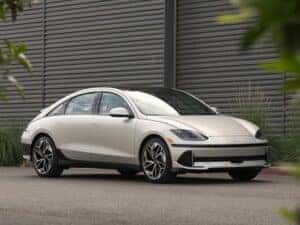
2023 Hyundai Ioniq 6
Chances are you value driving range or how far an EV can drive on a single charge, and rightfully so. You can find a gas station on nearly every street corner. Although charging stations are rapidly expanding, they aren’t quite as prevalent yet.
Even the most basic EVs today can handle daily driving, such as commuting to work, making grocery runs, and picking up the kids at school without the need to recharge. However, those road trips to the beach or the weekend ski trips need to be possible in an EV.
We find a clear winner when comparing the IONIQ 6 to the Tesla Model 3. The IONIQ 6 can travel 361 miles on a fully charged battery, whereas the Tesla Model 3 can only drive 333 miles on a full charge.
As for performance, the powertrain makes all the difference. The IONIQ 6 and Tesla Model 3 offer two powertrain configurations. First, the IONIQ 6 has a single electric motor in a rear-drive setup. This powertrain puts out 225 horsepower and 258 lb-ft of torque. The dual-motor all-wheel-drive powertrain produces an impressive 320 horsepower and 446 lb-ft of torque.
Tesla’s base model puts out 283 horsepower and 302 lb-ft of torque. The Model 3 has a top-tier Performance trim that offers 445 horsepower and 487 lb-ft of torque, also in a dual-motor configuration. IONIQ 6 and Model 3 cars with dual-motor designs can race from zero to 60 mph in under 5 seconds.
Hyundai EV Charging Infrastructure
According to PlugShare, Fort Worth, Dallas, and Arlington have 2,466 charging stations, 486 of which provide free charging. You have 405 Tesla charging stations in the same region. Charging speeds vary depending on the EV model and the type that each station offers.
For example, Level 1 charging uses the same three-prong plug you can use in any home outlet. While this makes for convenient usage anywhere, it’s the slowest method of charging. According to the U.S. Department of Transportation, Level 1 charging can take 40-50 hours to charge up to 80% capacity.
A Level 2 charger works with higher-rated equipment on a 240-volt electrical outlet similar to what your clothes dryer and electric oven plug into. Most EV owners install a Level 2 charger in their homes for convenience. Level 2 charging can charge from empty to 80% in as little as four hours.
Level 3 charging provides optimal rates using DC fast-charging technology. Most Level 3 chargers can charge up to 80% in as little as 20 minutes.
You can use multiple charging plugs with Hyundai EVs. This flexibility allows you to charge at any of the over 2,000 stations in the Dallas-Fort Worth-Arlington area. Tesla uses its Supercharger plug, which you can only operate at a Tesla charging station.
While this means you always charge a Tesla at the highest rate, it limits you to the 405 local Tesla stations. There are 563 non-Tesla fast charging stations in the area, which means the flexibility of Hyundai charging gives you access to a broader charging network.
Hyundai EV Interior and Technology
Both vehicles offer spacious interiors with excellent legroom for your rear passengers. The IONIQ 6 uses a beautiful and durable synthetic material, Hyundai’s H-Tex upholstery, whereas the Model 3 comes with vegan leather upholstery, which sounds good but means the material is vinyl.
The Model 3’s interior takes a minimalist approach to its design. You’ll find everything operates through the 15-inch touch screen, including climate control, and you won’t see a dashboard or center stack with buttons or knobs. Unfortunately, Tesla offers very few interior options.
The IONIQ 6 favors modern design cues, such as the 700-pixel LED lights that enhance design and emotion. Controls are intuitively placed for easy operations, and the 12.3-inch touch screen operates all your infotainment. In addition, you have Bluelink, Hyundai’s remote connectivity application that allows you to start your IONIQ 6, set the climate controls, and unlock it from anywhere.
Hyundai EV Pricing and Trim Levels
Tesla makes the Model 3 in three trims. According to the Kelley Blue Book, the Base trim costs $40,240, the Long Range trim costs $47,240, and the Performance trim starts at $53,240.
Hyundai offers four trim levels. The SE Standard Range model starts at $41,600, while the SE begins at $45,500. The SEL trim has an MRSP of $47,700, and the top-of-the-range Limited model is priced at $52,600.
Both vehicles qualify for the $7,500 federal tax credit.
Ownership Costs
EVs have a lower cost of ownership than gas-powered cars. Fewer parts result in less maintenance. Electricity costs less than gas, resulting in more savings. The IONIQ 6 has a 151 MPGe rating, and the Model 3 has a 132 MPGe rating.
Hyundai offers a $1,100 credit toward a home charging station installation, and you get two years of complimentary 30-minute fast charging sessions at any Electrify America charging station.
Environmental Impact
Hyundai and Tesla use sustainable materials to manufacture their vehicles. Switching to an EV helps the environment with zero tailpipe emissions and no wasted energy. Gas engines traditionally only use 40% of the energy from combustion to power the car, and the rest is wasted.
2023 Hyundai IONIQ 6 for the Win
The IONIQ 6 and Model 3 offer a desirable EV performance. The Hyundai IONIQ 6 has a longer range, better MPGe, and more charging options, making it the better choice. We encourage you to test-drive the IONIQ 6 and Tesla Model 3 to see which vehicle you prefer. Afterward, you’ll see why the IONIQ 6 earned Car and Driver’s EV of the Year award.
0 comment(s) so far on 2023 Hyundai Ioniq 6 Vs Tesla Model 3